

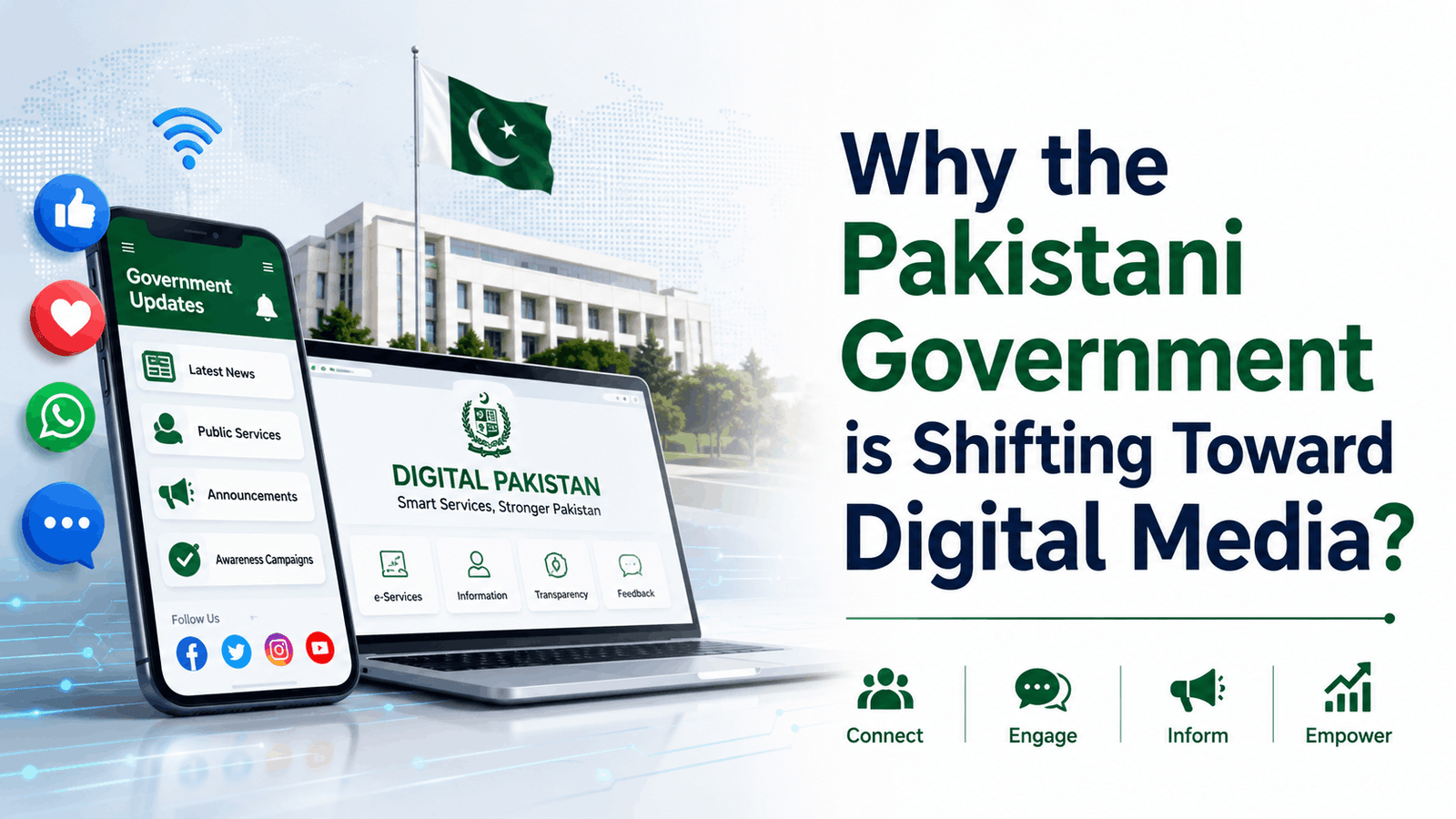
In today’s media environment, Pakistan’s Government is in the midst of a communications revolution. The once dominant mass media – print, television and radio – are being replaced with digital media.
This isn’t a temporary phenomenon. It is a transformational shift that has been driven by the evolution of technology, shifts in consumer habit, the call for transparency, and the need for more effective and accountable communication channels. With Pakistan’s economy and governance moving towards digital, digital media is a key element in the public sector’s communication strategy.
Government agencies, regulatory authorities, and public information offices are now favouring digital channels to send out faster, more relevant and effective messages.
1. Expansion of Internet and Smartphone Usage in Pakistan
The rise of the internet and smart phone usage in Pakistan is one of the key factors contributing to this change. In the last ten years, millions of people have access to mobile internet and this has changed the way we digest information.
Now, many people use:
- Facebook for news and updates
- YouTube for educational purposes
- Instagram and TikTok for micro-blogging
- Online news sites for breaking news
- Mobile apps for government services
This growth in digital media means that people are no longer reliant on the traditional media for their news. Therefore, government messages need to be present where citizens are consuming information, i.e. online.
This is a key reason why the government is investing in digital media strategies.
2. Demand for Faster and Real Time Communication
With traditional media, information is published at scheduled times and according to editorial cycles, which can lead to delays. But digital media enables:
Instant publication of information
Real time updates during emergencies
Real time correction of inaccuracies
Instant and uninterrupted communication
That immediacy makes digital platforms vital to governance, particularly in situations where public safety or consciousness is required.
3. Cost Efficiency and Optimization of Public Spending
Government communication comes at a cost. Conventional advertising channels like TV campaigns, print ads and billboards are often expensive to produce and place.
Online channels offer a more cost effective solution through:
Budgeting to suit small and large campaigns
Pay per click and other performance based ads
Minimising waste through targeting
Real time optimisation and testing
This provides the government with greater reach for its money, making better use of tax payers’ money and providing greater transparency in deployment of public funds.
4. Advanced Targeting and Audience Segmentation
Unlike traditional media, which broadcasts messages to a general audience, digital media allows highly precise targeting. This is particularly important for government campaigns because different messages are intended for different segments of society.
For example:
- Tax awareness campaigns can target business owners and professionals
- Health campaigns can focus on families and caregivers
- Educational initiatives can target students and youth
- Agricultural advisories can be directed toward rural communities
Digital platforms allow segmentation based on:
- Age
- Gender
- Location
- Language
- Online behavior
- Interests and preferences
This ensures that government messages are not only widely distributed but also highly relevant to the intended audience, improving communication effectiveness.
5. Data Driven Governance and Performance Measurement
Accurate measurement is one of the most significant benefits of digital media. This is in contrast with traditional media where it is necessary to estimate the results.
Government institutions can track:
- Total reach and impressions
- Likes, shares and comments
- Click through rates on awareness campaigns
- Audience demographics and behaviour
- Regional performance of campaigns
This analytics based strategy allows government departments to make more effective and efficient decisions, optimise their campaigns and maximise the return on investment (ROI) on public communications.
6. Combating Misinformation and Strengthening Information Control
In the digital era, social media and online platforms are a source of misinformation. This poses a significant problem for governments, as misinformation can shape public opinion and cause confusion.
The Government of Pakistan can quickly counter such misinformation by:
- Providing official statements immediately
- Dispelling misinformation instantly
- Distributing official information to the public
- Tracking public discussions and trends
This is crucial for building confidence, and to inform citizens in a timely manner.
7. Increased Public Engagement and Two Way Communication
Traditional government communication has historically been one directional, where information flows from institutions to the public. Digital media has changed this model completely.
Now citizens can:
- Comment on government announcements
- Ask questions directly on official pages
- Provide feedback on policies and campaigns
- Participate in online awareness initiatives
- Share government content within their networks
This two way communication enhances transparency and builds stronger trust between government institutions and the public. It also allows policymakers to better understand public sentiment and expectations.
8. Crisis Communication and Emergency Response Efficiency
Effective communication during emergencies is critical for public safety. Whether it is a natural disaster, health emergency, or security situation, timely information can save lives.
Digital media enables governments to:
- Issue instant alerts and warnings
- Provide live updates during emergencies
- Correct misinformation quickly
- Share safety instructions directly with citizens
This makes digital platforms an essential tool for crisis management and emergency response systems.
9. Shift in Global Communication Standards
The shift toward digital media is not unique to Pakistan. Governments around the world are adopting digital first communication strategies as part of broader governance reforms.
Global trends include:
- Digital public service delivery
- Social media based public communication
- Data driven policy messaging
- AI powered communication tools
Pakistan’s adoption of digital media aligns with these global standards, helping modernize its public communication infrastructure and improve governance efficiency.
10. Integration of Digital Media with Traditional Channels
It is important to note that the shift toward digital media does not mean the complete elimination of traditional media. Instead, governments are adopting a hybrid communication model.
This integrated approach includes:
- Television and print media for mass awareness
- Radio for rural outreach
- Digital platforms for targeted engagement
- Social media for real time interaction
This combination ensures maximum coverage while maintaining precision and engagement across different population segments.
11. Role of PID Registered Agencies in Digital Transformation
In Pakistan, the Press Information Department (PID) plays a key role in managing government advertising and media buying. PID registered agencies are now evolving to include digital capabilities alongside traditional media services.
These agencies support government communication by:
- Executing multi platform campaigns
- Ensuring compliance with official communication standards
- Managing media buying across traditional and digital platforms
- Delivering structured and measurable campaign outcomes
This integration ensures that government communication remains efficient, transparent, and aligned with modern digital requirements.
12. Conclusion
The Pakistani government’s move to digital media is a strategic evolution in light of technological innovation, consumer behaviour, economic considerations and the need for instant communication. The online world offers governments efficient avenues to communicate instantly, directly and accurately with their people.
With the increasing uptake of digital in Pakistan, digital media will continue to be central to government communication. This shift is not only enhancing communication and efficiency but also transparency, accountability, and citizen participation in the government.
FAQs
The Pakistani government is shifting toward digital media because it provides faster communication, wider reach, lower costs, and better engagement with citizens compared to traditional media.
Digital media helps government institutions share announcements instantly, run awareness campaigns, provide real time updates, and communicate directly with the public.
Digital media is not fully replacing traditional media. Instead, the government is using a hybrid model that combines TV, radio, print, and digital platforms for maximum impact.
Digital media allows better budget control, targeted advertising, performance tracking, and reduced waste, making it more affordable than large scale traditional advertising.
Yes, digital media is highly effective during emergencies because it allows instant alerts, live updates, safety instructions, and quick public communication.